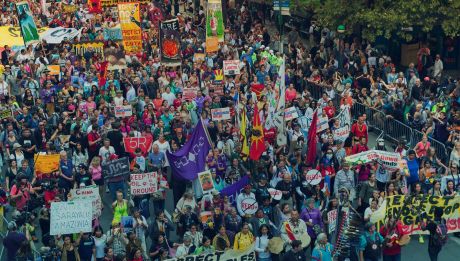
September 21 saw the largest climate march in history. With around half a million people in the streets of New York City and 2646 solidarity events in 162 countries, it was impossible for the leaders of world gathered there for the UN Climate Summit to ignore the demand for real action on this issue.
The march itself is an incredibly important moment in history, now regarded as both a reference point and a turning point on climate change. As Bill McKibben tweeted at 4:03pm, September 21: “The day the Climate Movement came of age. It took 25 years, but better late than never.”
We should celebrate the labour and achievement of the organizers that pulled together such a momentous event. Because of them, we are able to take a (very) momentary sigh of relief, re-group and move on to the next actions.The size of these rallies provides a new reminder that we can bring about change, and that everyone can take an active role in creating that change. The website itself provides a contemporary case study in effective organizing, and participation, and looking through the pictures on the People’s Climate March site is an inspiring way to spend a few minutes: http://peoplesclimate.org/wrap-up/, as well as to understand what unity is all about.
What are the other facts coming out of the People’s Climate March and what is next for our movement?
The march forced U.S. President, Barrack Obama, to state to the Summit on September 23: “the climate is changing faster than our efforts to address it. The alarm bells keep ringing. Our citizens keep marching. We cannot pretend we do not hear them. We have to answer the call”.
He outlined steps the U.S. will take; noted that as the world’s largest economy, the U.S. has a leadership role to play; and called on all major economies to lead the way and invest in eco-energy initiatives. In true capitalist form, he also stated that developing countries have a leadership role to play. Really? While they’re literally drowning and starving to death? This is from a man whose administration - as so well outlined by Paul Street in “Imagine Living in a Socialist USA” – has undermined global efforts on carbon reduction at both the Copenhagen and Durban climate conferences; enabled offshore drilling; betrayed promises to Labour; slashed social funding; frozen federal wages and salaries all while continuing Bush’s tax cuts for the rich and ensuring the future for globalization. Not to mention the health-care debacle. Obama also appropriated Dr. Martin Luther King’s legacy by quoting him: ‘there is such a thing as being too late’. It would have been truer to Dr. King’s legacy had he used a different King quote from his essay “A Testament of Hope” - the real issue to be faced is “the radical reconstruction of society itself”.
While the American President felt the pressure to attend the Climate Summit, Canadian Prime Minister Harper was one of a very few heads of state that did not attend the summit. Even though he did make a trip to New York on the same days.
Reforms might improve people’s lives to some extent, but they will not come soon enough, nor be enough. Obama noted that we are the last generation able to do anything about climate change if our children are to have a future. He looked distinctly uncomfortable delivering his speech to the summit, it felt forced, and his aides looked harried. Those are telling reveals. His speech was met with huge applause, but stellar oration and rhetoric aside, and fighting the urge to yawn, an intensified pressure is definitely being felt by our politicians and a renewed sense of urgency to take action on climate change since the march.
Perhaps the most important development coming out of the march is the much stronger unity and breadth of organizations active in the movement who see themselves with a role to play and as having a message that must be heard. Indigenous People’s joined together with Labour, faith, the LGBTQ2S community and environmental organizations and all spoke with a unified voice.
This succeeded in opening up space for a deeper, more radical examination of what is causing the climate crisis and tied it directly to capitalism (as well put by Naomi Klein). It also urges deeper and again more radical examination of solutions. It raised a big question about the argument of the 1% - (that capitalism can somehow be reformed) and answered it loudly with our belief - that we need to end capitalism, that it cannot be reformed if we are to survive.
We need to remind ourselves, as effective Socialists, that: our commitment to bring about a socialist world is more important now than ever; we literally have no time to despair, but we can use dismay as fuel for our own fire; that unity and collective struggle is the path to a better world; and that we are achieving victories along the way.