Friday night August 25 at the Sky Dome in Toronto, Bruce Springsteen & the expanded E Street Band led the crowd in a kind of revival meeting without religion. What was elevated was not the power of God or a higher being, but the power of the ordinary, of ordinary people trying to get by in hard times.
If the performance in Toronto is representative of the tour for Springsteen’s new CD, Wrecking Ball, and I think it is, this is the best Springsteen & the band have been in years. It has to do not only with the fact that they are brilliant musicians and Springsteen is a master storyteller, but with the times we are living in. Springsteen has said himself that Wrecking Ball was inspired in part by the Occupy movement.
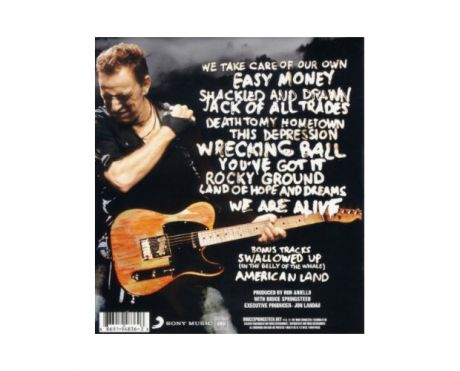
After beginning with what he called three summer songs to get the crowd moving, the band launched into three songs from the new CD: We Take Care of our Own, Wrecking Ball and Death to my Hometown. These songs are about the economic meltdown which began in 2008 and from which American workers and the poor have never recovered.
An implicit critique of capitalism has often been there in much of Springsteen’s work, but in the new album this critique has moved front and centre. There’s no ambiguity about who is to blame in the rousing “Death to my Hometown”:
“robber barons…the greedy thieves who came around
And ate the flesh of everything they found
Whose crimes have gone unpunished now
Who walk the streets as free men now.”
The title song, Wrecking Ball, ostensibly about the demolition of the Giants Stadium in East Rutherford, New Jersey, becomes a metaphor for much more – mortality, the passing of time, Springsteen’s own history—“I was raised outta steel here in the swamps of Jersey some misty years ago”—but also the economic wrecking ball that has shattered so many small hopes and dreams. As the song rang out under the stars in Toronto it was also a shout of defiance and an exhortation against despair:
“Hold tight to your anger
Hold tight to your anger
Don’t fall to your fears.”
The night was a tour of Springsteen’s career and the shared experience of those who are currently with him and those who are no longer. Springsteen talked about getting older as partly a question of getting used to living with ghosts. He referred to two E Street Band regulars who have passed on—Danny Federici and most notably Clarence Clemons—the Big Man who played saxophone with Springsteen for over 40 years. There was a moving tribute to Clemons with images projected over the jumbotrons. The stadium stood and clapped for the duration of the tribute.
But this was not a night for nostalgia only. The audience was multi-generational and the composition of the expanded E Street band also spoke to this. Clarence’s nephew Jake Clemons has been playing sax on this tour, along with an expanded horn section, back-up singers and other musicians from the Peter Seeger sessions.
Springsteen was able to forge a collective experience by mining the riches of his musical past and present. He did a haunting piano solo of Incident on 57th Street from 1973’s The Wild, the Innocent and the E Street Shuffle; classics like Candy’s Room, Prove it all Night, and Spirit in the Night; and then feel-good sing along favourites like Dancing in the Dark, Badlands and Glory Days.
But threaded throughout the night were reminders of our collective past and present. The ghosts Springsteen talked about were not only his own personal remembrances but the ghosts of all those who have resisted the “wrecking ball”:
“A voice cried I was killed in Maryland in 1877
When the railroad workers made their stand
I was killed in 1963/One Sunday morning in Birmingham
I died last year crossing the southern desert
My children left behind in San Pablo
Well they’ve left our bodies here to rot/Oh please let them know
We are alive
And though we lie alone
Here in the dark
Our souls will rise
To carry the fire and light the spark
To fight shoulder to shoulder and heart to heart.”
Springsteen and the band played a full 45 minutes after the house lights came up, although he kept joking that the plug might be pulled after every song. A marvel at 62, Springsteen crossed the stage back and forth, interacted with audience members, including dancing with a woman whose husband had a sign reading “Please dance with my wife on our anniversary.”
His energy was returned by the Toronto audience. As Bruce came off the stage after three hours and 37 minutes, he said to his team, “That was the greatest audience we have ever had in Toronto.” The evening was a testament to the restorative power of music and resistance.