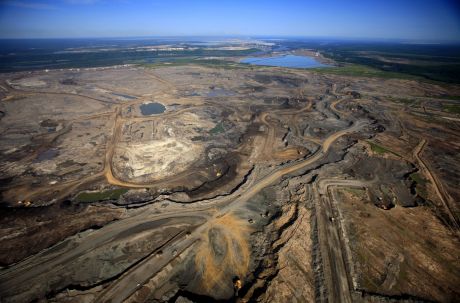
THE TAR Sands development in northern Alberta is an ecological nightmare, and an insult to indigenous land rights. This nightmare and this insult are profoundly Canadian—shaped by Canadian corporations and Canadian government policies.
In December 2012, the federal government approved the decision of the share-holders of Tar Sands oil company Nexen to allow itself to be taken over by the state-owned Chinese oil company China National Offshore Oil Corporation (CNOOC). At the same time, the federal government was in secret negotiations on a free trade deal with China, an issue that the Tories would not allow to be debated in Parliament. This led to much discussion about the role of Chinese government-owned corporations in Canada.
Opponents to the trade deal and the take-over of Nexen rightly point to the human rights record in China, and to a system that allows less democracy for its citizens than Canada’s. But some have gone further and see a danger—that the relationship between Canada and China could become the opposite of the traditional relationship between a rich country and a poor country, that Canada could somehow become a colony of China.
In May 2012, Nikki Skuce from ForestEthics Advocacy analyzed the ownership of corporations exploiting the Tar Sands in a report called “Who Benefits? An Investigation of Foreign Ownership in the Tar Sands.” Based on share ownership of oil companies, she concluded that “the vast majority of Tar Sands production is not owned by Canadians,” and singles out the growing role of “rising Chinese Investment.” In the section on China, she claims that this is “positioning Canada as China’s resource colony.” The conclusion of the article is that the majority of profits and jobs created by the Tar Sands are being shipped outside of Canada.
Elizabeth May, leader of the Green Party, while highlighting concerns about the trade deal between Canada and China, also came to the conclusion that Canada would “become the resources colony in that context.”
Canada does have a colonial history, but Canada is the colonizer. This is a story of colonial violence, carried out by the newly created Canadian state, directed against the Cree, Assiniboine, Métis and other peoples, as Canada used force to consolidate its developing capitalist economy. Canada is not a victim of colonialism, but is rather a colonial power in its own right.
That is unlikely to change. China might be undergoing a massive industrial revolution, but it remains a society far more impoverished than Canada. In this context, singling out China’s role in the oil fields runs the risk of opening the door to racism in the environmental movement.
In an article on his blog, Paul Kellogg disputes that control over the Tar Sands is predominantly in non-Canadian hands. Using Statistics Canada data going back 60 years, he shows that Canadian companies have increased their share in the Tar Sands such that they now account for around two-thirds of those companies. While acknowledging that the majority of shares in companies responsible for the horror of the Tar Sands are not owned by Canadians, he points out that it is the one or two largest share-holders that effectively control a company. He argues that, in the case of Tar Sands oil companies, that control still remains in Canadian hands.
However, final control over the Tar Sands does not rest in the hands of the corporations exploiting them. It is shared between the Alberta government, the Canadian government and the irrational market. The recent boom in the Tar Sands has occurred only because oil prices have risen. Capital, no matter of what nationality, goes where the profits are; when oil prices decline, so will Tar Sands development and extraction. In addition, there can only be mining if the provincial and federal governments allow it. The Tar Sands have been developed because successive Liberal and Tory governments have put profits before people and the environment.
This argument over who has more control and who is getting most of the profit and where the refining jobs are located leaves out the most important question: how can we build a movement to shut down the Tar Sands and replace those jobs with better paying climate jobs?
It doesn’t matter where the profits from the Tar Sands are going, exploiting this resource is destroying the immediate environment where mining is underway, the process is poisoning nearby rivers and it’s contributing to climate change that already kills 140,000 people a year, according to the World Health Organization.
Our movement needs to be absolutely clear: the Tar Sands are a Canadian creation, and it’s our responsibility to shut them down.