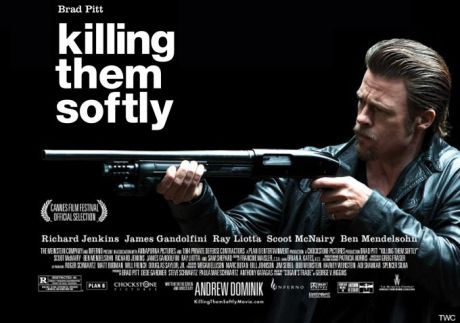
This is a movie about what current day America is without solidarity, without any kind of collective response to the economic meltdown of 2008 and the repercussions since then.
Often the most important questions in US political and social life are broached in movies about the mob-either the grandiose version in The Godfathers I & II or the street hustler variety in Martin Scorsese’s Mean Streets.
Killing them softly falls into this tradition with a kind of mid-level mob culture. Brad Pitt, in a great chilling performance, is the hired killer who’s called in to fix a mess wrought by two guys barely surviving on the edge of drug addiction and getting by any way they can. They execute an ill-planned heist of a Mob-protected card game, complete with yellow rubber gloves, more suited to cleaning toilets than holding their guns. In spite of their goofy demeanor, they successfully make off with the dough, causing the local criminal economy to collapse. Pitt is then called in to fix the situation.
There are several great scenes between he and the fine character actor Richard Jenkins, playing a mob lawyer, discussing what the higher-ups want done about the ‘situation’.
The film is directed by New Zealand-born Andrew Dominik, who also directed Brad Pitt in another quintessentially American tale, The Assassination of Jesse James by the Coward Robert Ford.
He has a penchant for slow-motion close-ups and there is one here used to great effect near the end of the film where Pitt paces in slow motion amid bursting fireworks. The fireworks are for Barack Obama. The movie is set during the climax of the American presidential elections and the economic slump.
Killing them softly was filmed in New Orleans, although it’s unrecognizable in the film, because most of what we see is urban desolation—parking lots, dumps, depressing tract housing. Fitting, nonetheless, that in a film that points to the utter uselessness of mainstream politics in the US, amid shots of Bush and Obama vying to ‘fix’ America, the setting should be the same city that suffered through Hurricane Katrina and was abandoned by Bush and his cronies.
But Obama offers very little to challenge Bush’s dog-eat-dog society, especially knowing now what we didn’t necessarily know then. At the beginning of the movie we hear Obama promising “the freedom to make of our lives what we will.”
This must seem like a sick joke to most of the characters in Killing Them Softly, although by and large they are not following any of the election messaging. It’s simply there in the background, in the same way that Warren Beatty used the Nixon re-election campaign in 1972, as a backdrop to his commentary on the state of US society in Shampoo.
Killing them softly sets up a commentary on the economic collapse in the microcosm of the mob world, which is mirrored in the larger society. These are all characters for whom the struggle to survive is about avoiding the violent retribution of their own.
There are virtually no police or agents of the state in this movie. The gangsters don’t need them because they are very much a self-regulating society. And violence is the final regulator.
You could say these people live by a very harsh code. But, again, if you look at what happened to ordinary people during and after the economic meltdown in the US-how many people lost their homes, their jobs, their pensions-and how little their government cared, then or now-it seems a short step to the kind of jockeying for position and individualism that runs rampant in Killing them softly.
Theirs is also a very misogynistic world. The only woman in the entire film is a black prostitute and the casual contempt with which women are treated in the conversations between the two hapless thieves speaks to the extreme alienation of this world.
In the last scene of the film Pitt punctuates this desolate world view when he says, “America isn’t a country. It’s a business. Now pay me my fucking money.”
Luckily, struggles such as Occupy Wall Street, the fight backs in Wisconsin and Michigan and the Chicago teachers’ victory, point to another way out of the crisis caused by capitalism.